Rhythm — The Boundary Becomes Time and Beats
Advance and Withdrawal
The Heart Beats by Resting
The year I turned fifty, I suddenly felt like a bowstring drawn to its limit. To shoot an arrow you must pull backward. You draw the string to your chest, hold your breath, aim, and release. The arrow flies in an instant, but the drawing takes a long time. And the time spent drawing decides the distance flown. In my younger days in Boston I once received more than twelve rejection letters in a row. At the time I thought my life was only retreating. Now I know that the retreat was in fact the time the bowstring was being drawn — that moving forward is not the only advance. There is one place in our body that shows this truth most honestly: the heart.
Seen in space a boundary is a membrane; seen in time it is rhythm. For a boundary is finally a going back and forth between this side and that, and going back and forth becomes, in time, a rhythm. Look at the heart. The heart does not only beat. It contracts and it relaxes. It squeezes and it releases. It advances and it withdraws. If the heart were to forget relaxation and only contract — that is rigidity, and that is death. The heart beats by resting.
There is a more astonishing fact. A healthy heart does not beat at a fixed rate. The interval between beats is always varying minutely. This is called heart rate variability (HRV), and the greater this variability, the healthier the person. Conversely, when the intervals become identical as a machine’s, it is a sign that the body has grown rigid and is in peril. Low heart rate variability is in fact used as an indicator predicting cardiac disease and mortality. As death draws near, the electrocardiogram moves toward a single straight line. A perfectly regular rhythm is not rhythm but arrest.
What is fixed is dead. What is alive beats in rhythm.
Physiology has its own name for this. For a long time we were taught that the body strives to preserve homeostasis — a set value. Body temperature 36.5 degrees; blood glucose such and such. But now we use the word allostasis, meaning stability achieved through change. A healthy body is not one that fixes its values but one that knows how to move them as circumstances require. It raises the heart when running and lowers it when sleeping. The wider that range, the healthier. Not a body that tries to hold still but a body that knows how to shift. This is the academic name for what this book calls rhythm.
What conducts this rhythm is the vagus nerve. The vagus nerve is the body’s brake. It settles an aroused body, slows the heart, switches on digestion and recovery. It is the nerve that makes a body that only advances withdraw. According to the theory of the neuroscientist Stephen Porges, this vagus nerve works best when we feel safe and are warmly connected with someone. The research of the psychologist Barbara Fredrickson found a remarkable upward spiral here: warm relationships strengthen vagal tone, and a strengthened vagus in turn makes deeper relationships possible. Which means the capacity for withdrawal is not built alone. Only when there is someone holding us up can we truly release our tension. The recovery of rhythm borders on the recovery of relationship.
I have long thought that health is the rhythm of advance and withdrawal. And I learned belatedly that this thought was not mine alone. The historian Arnold Toynbee saw that people who accomplish great things, and civilizations too, grow by the same rhythm, and he called it withdrawal and return. One who accomplishes something great does not win outright in the middle of the world. He first withdraws — into the wilderness, into solitude — is changed within, and returns with new strength to change the world. The inner journey Jung called individuation is no different.
What held me longest here was the name he gave this rhythm. Explaining the growth of civilizations, Toynbee took yin and yang from Chinese philosophy just as they were. Yin is rest and water; yang is activity and fire. And he called the genesis of a civilization one beat of a rhythmic pulsation running through the universe. A twentieth-century British historian, searching for a language to explain the whole of human civilization, arrived in the end at two characters used by the people of the Zhou.
People who did not know one another arrived at the same place.
One thing should be added. The concept of challenge and response is Toynbee’s. But long ago, teaching young people in Canada, I honed his insight into a single phrase and have since called history the dynamic of challenge and response. I could not find that noun form in his own text, so I leave it as my own phrasing. The concept is his; calling it that has been mine.
Someone else arrived at the same place. The I Ching takes this rhythm as its definition of maturity. At the final place of the hexagram Qian, pure ascent and creation, stands kanglong youhui: the dragon that has risen to the top has regret. The commentary reads: he knows advancing but not withdrawing; he knows persisting but not perishing. That is the illness of the one who has climbed all the way. And then it says: only he who knows advance and withdrawal, persistence and perishing, and yet does not lose their rightness — only such a person is a sage.
If asked what maturity is, I now answer this way. Not knowing how to advance further, but knowing when to advance and when to withdraw. The I Ching called it timeliness. The same act is auspicious when it fits the time and inauspicious when it does not. Advancing is not always right, nor is withdrawing.
Earlier I used the word wilderness for withdrawal. I want to give that wilderness a name. Moses, prince of Egypt, killed a man at forty and fled to the wilderness, where he spent another forty years tending sheep that were not even his own but his father-in-law’s. In that wilderness he had his first son and named him Gershom, meaning “I have become a sojourner in a foreign land.” Then he had a second son and named him Eliezer, meaning “He delivered me.” Nothing about the circumstances had changed. It was still the wilderness and still another man’s sheep. Yet two names were fastened to the same forty years.
The order matters. Gershom came first. Only the person who first fastens the honest name — sojourner — arrives later at the other name. To say from the beginning that everything is fine is not reinterpretation but evasion, and that is the coddling of Chapter One. For the person who never called a stumbling block a stumbling block, it never becomes a stepping stone.
Closing this chapter, let me set down one more thing. To someone enduring a withdrawal we say far too easily: grow more. But before a challenge one cannot bear, that word is cruel. If advancing is the success of yang, withdrawing has its own kind of success. A tree that has come through winter has not failed. That winter, standing bare with every leaf shed, waiting for spring, was not the tree’s failure but its wisdom.
The name the I Ching gives that winter is Fu, Return. The shape of the hexagram is its meaning. Five yin lines press down darkly above, and at the very bottom a single yang line is just sprouting. Above is earth and below is thunder: the place where, beneath frozen ground, the first tremor of spring begins. Of this place the I Ching says that in returning we see the mind of heaven and earth — that the mind of heaven and earth is not at the summit but at the bottom.
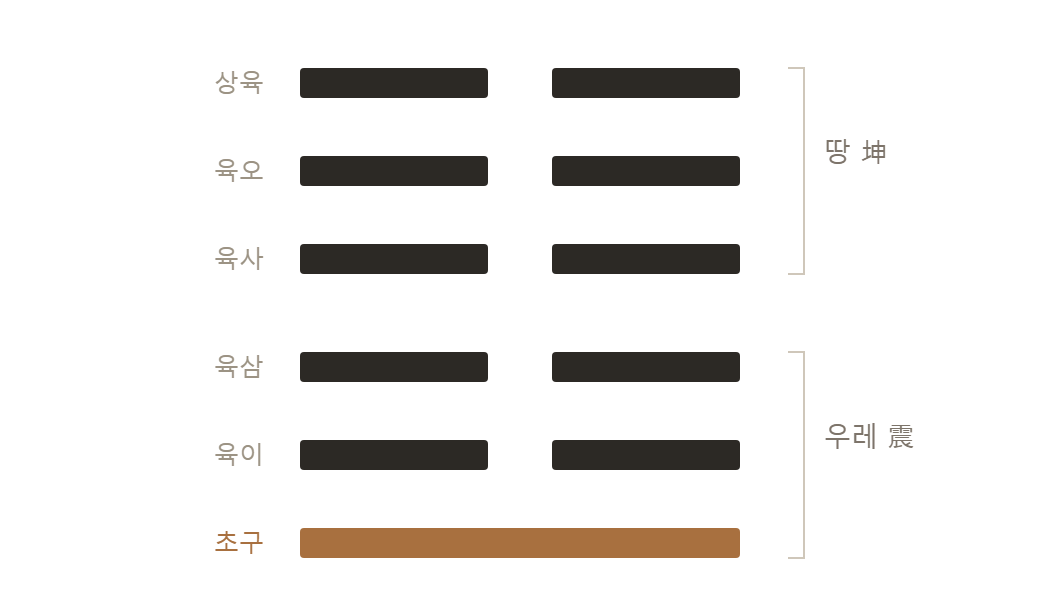
That there is only one yang line matters. Not five, but one. So we must not demand proof of recovery from a person standing in this place. Outwardly nothing yet looks different. Only the direction has changed. The I Ching attaches to that single line the phrase qiri laifu: in seven days it returns. Which means returning is not an achievement wrung out by effort but a property of rhythm.
Sometimes growth is success; sometimes surviving is itself success.
The I Ching did not speak of returning as one lump. It divided it into six places, because the single act of returning wears different faces. The bottom line, the first yang, is buyuan fu: returning quickly, before going far. It is called greatly auspicious. Above it the second line is xiu fu: returning together by leaning on someone who has returned first. The third is pin fu: falling often and returning often. It is called perilous, and yet without fault — because what was counted was not the number of falls but the number of returns. The fourth is du fu: returning alone from the very middle of the five yin lines — the place where one turns direction alone, away from the crowd one was walking with. The fifth is dun fu: returning thickly and with weight.
And the topmost line is mi fu: having missed the time to return. Alone among the six places it is called inauspicious, and a long warning follows. There is calamity; if one raises an army in this state one will suffer a great defeat in the end; and the aftermath reaches even the ruler, so that for ten years one cannot rise again. It is rare for the I Ching to speak at such length about a single place. What is inauspicious here was not withdrawing. It was missing the time to withdraw.
That the place called beautiful among the six is xiu fu stays with me a long while. The character xiu, rest, sits in the very middle of returning. And the commentary gives the reason for its beauty: because one humbled oneself before the worthy person below. Which means returning by leaning was rated higher than returning alone. We will meet this character again later.
The illness of a life that only swells now gets one more name: mi fu — a life that only advances and does not know how to withdraw, a heart that contracts and cannot relax. That rhythm hardens toward a single straight line. The way to save such a person is not to make him beat harder but to help him recover how to beat by resting. And the secret of that rest we will find, in the next chapter, in a single breath.
Notes for this chapter
Allostasis — Sterling & Eyer (1988), McEwen (1998) NEJM 338(3):171–179 · Stephen Porges, polyvagal theory (2011) · Kok et al. (2013), Psychological Science 24(7):1123–1132 — the upward spiral of warm relationships and vagal tone · Arnold Toynbee, A Study of History — the yin-yang rhythm, vol. 1 p. 201; cosmic pulsation, vol. 1 p. 205 · I Ching, Hexagram Qian, “Wenyan”; Hexagram Fu (Earth over Thunder), the judgment and “Tuan” commentary (fu qi jian tiandi zhi xin), the six line statements (buyuan fu, xiu fu, pin fu, du fu, dun fu, mi fu) and the “Xiang” commentary on the second line (yi xia ren ye) · Exodus 2:22, 18:3–4