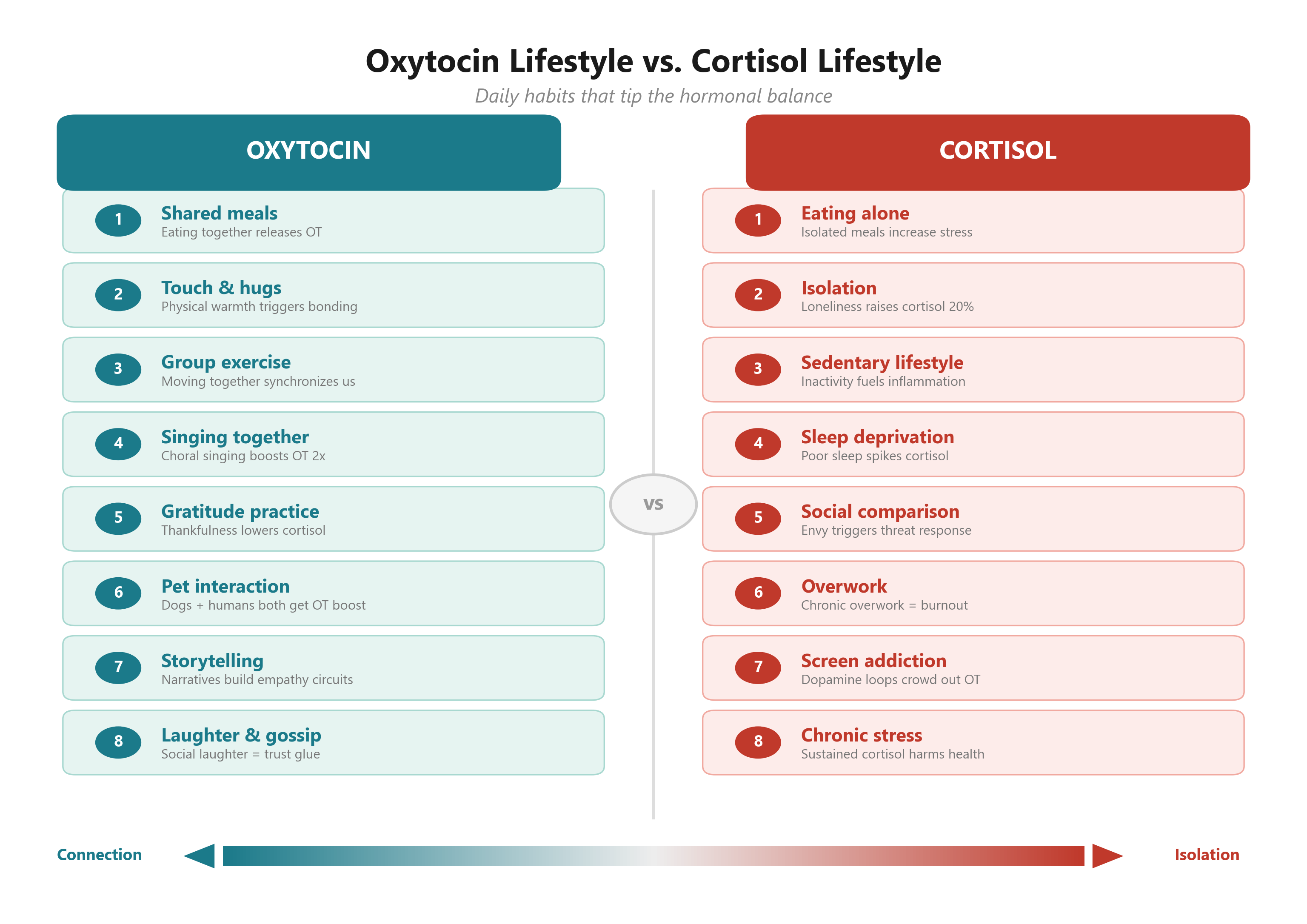
-- Choose the Oxytocin Lifestyle
Stress keeps us alive.
Wait — stress keeps us alive? Is that not backward? Is stress not the thing that kills us? In strictly biological terms, stress itself is not the problem. Chronic stress is the problem. Acute stress — the kind that hits fast and passes quickly — is the reason our species survived long enough to build civilizations.
Professor Robert M. Sapolsky, the world's leading expert on stress, explains this brilliantly in Why Zebras Don't Get Ulcers. Zebras spend their lives being chased by lions. They experience intense bursts of stress. And yet they never develop stomach ulcers. Why? Think about what happens inside a zebra's body when it sees a lion charging.
In a life-or-death crisis, the body ruthlessly triages. Reproductive function? You are about to be eaten — mating can wait. Digestion? You are about to become someone else's meal — your own dinner is irrelevant. Immune system? Growth? These are luxuries for creatures who survive the next sixty seconds. What matters right now is flooding the leg muscles with blood. Every other organ gets cut off. To make this happen, heart rate skyrockets and blood pressure spikes.
The conductor of this emergency response is cortisol, the stress hormone, along with adrenaline and the full activation of the sympathetic nervous system. Once the zebra escapes, the system reverses: stress hormones and adrenaline drop, the parasympathetic nervous system takes over, and blood starts flowing to the organs again.1
\ The Korean edition was published under the title Stress: Everything About the Stress That Makes You Sick.
Eustress and Distress
Hans Selye, the Canadian endocrinologist known as the father of stress science, argued in The Stress of Life that the right dose of stress can genuinely energize you. Working at the University of Montreal, he developed the "general adaptation syndrome," a three-stage model of the body's stress response. In the alarm stage, the adrenal glands release adrenaline and cortisol, speeding up breathing, increasing sweat, and heightening anxiety. If the stress continues, the body mobilizes hormonal defenses to fight back (the resistance stage). When the stressor finally passes, the parasympathetic nervous system kicks in, bringing relaxation, rest, and recovery (the exhaustion stage). Selye showed clinically that when stress is not discharged in time, it becomes a lethal poison.2
But Selye made a second, more surprising claim: stress, handled the right way, can enrich life rather than destroy it. He coined "distress" for the harmful kind and "eustress" for the energizing kind. Eustress, he argued, is the butterflies before a first kiss, the electric anticipation before a big game or a concert, the thrill of planning a trip overseas. These experiences do not drain us — they charge us up. Distress, on the other hand, comes from relentlessly unpleasant stimuli: the death of a loved one, work overload, constant arguments, the neighbor's noise at 2 a.m. Selye's advice was to break stress into manageable chunks with rest in between, shift your perspective, and cultivate more eustress. Do this, he said, and stress is no longer the root of all disease. It becomes one of life's unexpected gifts.3
Modern humans are not going to run into a tiger or lion on the street. Barring a zoo escape, the probability is essentially zero. (Though the recent spate of random knife attacks in public has introduced a terrifying new kind of street-level threat.) So where does a modern person experience the kind of existential terror a zebra feels when it spots a lion? At home. At school. At work. In the social world.
When a student gets bullied or crushed by the pressure to maintain a place within a friend group, cortisol surges. Research suggests that prolonged stress during adolescence can actually suppress physical growth. For adults, the biggest stressors are likely the relentless performance pressure at work and the minefield of office relationships: demands from above, competition from peers, jealousy, sabotage, the slow grind of being undervalued — each of these produces a hormonal response indistinguishable from a zebra meeting a lion.
The critical difference: a zebra's terror lasts seconds, maybe minutes. Ours can last months. Years. If workplace stress can be discharged through a warm home, through hobbies and friends and weekend activities, the system works the way nature intended. But if there is no one at home to lean on, no friend to share a therapeutic round of gossip about the terrible boss, no community or hobby to turn to — that is not just unfortunate. It is a serious health threat: physical, psychological, and social.
The key to converting distress into eustress is making the oxytocin lifestyle the operating system of your daily life. You need to find ways — right now, today — to pump oxytocin through your body. When you do, cortisol will drop. And life will start to feel different.
The Stress Killer: Oxytocin
Stress and oxytocin are more tightly connected than most people realize. The brain structures that secrete stress hormones and those that release oxytocin sit right next to each other — they are anatomical neighbors. In a healthy body, when stress arrives, oxytocin rises alongside cortisol, buffering the stress response and nudging cortisol back down. But when cortisol surges without a matching rise in oxytocin, the person is left exposed to the full force of chronic stress — physical, mental, and social.
This is why the oxytocin lifestyle is not a luxury. It is a necessity. No matter how much we tell ourselves that stress brings productive tension and creative energy, stress that exceeds our personal threshold and goes unaddressed is a slow-moving disaster. Chronic stress is the root of all disease.
We need to rebuild our daily routines around the oxytocin lifestyle. When stress finds you at school or work, call a friend right away — share a meal, talk it out, let the words carry the weight. On weekends, play sports outdoors together. Sit at a cozy cafe over brunch and let the gossip about your boss flow freely. Join clubs. Pick up hobbies. Let the stress drain from your body. If no friends come to mind, do not give up — visit your parents and give them a massage. Join a neighborhood sports club. If exercise is not your thing, try a community lecture series or a book club — any gathering where you meet new people and feel the warmth of shared experience.
And there is one more part of the oxytocin lifestyle that deserves a mention: spiritual community. Walk into a nearby church, clap your hands, sing, listen to a sermon, enjoy the communal lunch afterward. If church is not for you, try a Buddhist temple. Listen to the dharma talk, eat the temple food. And if you are already there, a light hike afterward — just enough to break a sweat — makes everything better.
The most important point — which I will explore in more detail in the next chapter — is learning to separate what you can change from what you cannot in the things that stress you. What you can change, change now. What you cannot, accept or actively look for alternatives. Say your boss bullies you daily and leaving the job is not an option. Consider making an ally of your antagonist. There is a line in scripture: "Use worldly wealth to gain friends for yourselves" (Luke 16:9). In other words, heap burning coals on your enemy's head — with kindness.
I lived this lesson myself. In graduate school, there was a colleague who needled me constantly — passive-aggressive jabs that sent my blood pressure through the roof. Maybe I should just deck him, I thought, briefly and darkly. Then I changed my mind. That Christmas, I gave him a modest gift with a carefully written, heartfelt card. From that day on, he was a different person. He became one of my closest friends, and we are still in touch today.
Outcomes like that are not common, I grant you. But when you are stuck in a stressful situation, doing something positive — something that sends oxytocin rather than cortisol into your bloodstream — can change the whole trajectory. That is the oxytocin lifestyle in its simplest form. Live this way long enough, and your attitude will shift, your circumstances will change, and even the situations that once tormented you will start to look different.
The Relationship Between Oxytocin and Cortisol
| Oxytocin High | Oxytocin Low | |
|---|---|---|
| Cortisol High | Health Maintained | Health Threatened |
| Cortisol Low | Health Improved | Health Maintained |
End of Part 7