--- Oxytocin as a Potential Treatment
Aristotle famously called human beings social — or political — animals. It is one of those statements that everyone nods along to while feeling slightly uneasy about the word "animal." In The Origins of Happiness, Professor Seo-eun Guk argues that happiness is not life's ultimate goal but a survival tool — that happy people outlast unhappy ones in the long run. Guk goes so far as to describe humans as "one hundred percent animal" and stages a provocative face-off between Aristotle's idealism and Darwin's evolutionary theory. His framing stirred debate. But his conclusion circles back to familiar ground: what matters most for happiness is sharing your feelings and thoughts with others, and maintaining meaningful, lasting relationships.
Reading the Mind in the Eyes
Emotion is one of the most fundamental parts of who we are. Before we are rational, before we are logical, we are feeling creatures. When we cannot read our own emotions or interpret those of others, we fall into what might be called emotional illiteracy. The American psychotherapist Claude Steiner argued that just as literacy means the ability to read and write, emotional literacy is the ability to perceive another person's feelings and express your own in productive ways. An emotionally literate adult does not weaponize feelings, does not throw tantrums when emotions go unvalidated, does not demand comfort while refusing real conversation. Such a person can channel emotion toward personal growth, conflict resolution, deeper connection, and a stronger sense of belonging.[21-1]
Karla McLaren makes a complementary argument in The Language of Emotions: a socially healthy person is one who can read others' emotions and respond accordingly. McLaren observes that modern culture — shaped by relentless media messaging — has taught us to treat emotion as the main disruptor of relationships, something best suppressed. We learn to see public displays of feeling as taboo, to project constant positivity, to keep our inner weather behind a calm surface — all while secretly monitoring the emotional states of everyone around us. These myths, McLaren argues, shatter the moment we face real emotional loss, communication breakdown, or mental illness.[21-2]
The German poet Christian Friedrich Hebbel once wrote: "The eye is the point where body and soul meet." The information carried by a gaze is a signal from the deepest part of the self. And this is exactly the channel that autism disrupts. Children on the autism spectrum struggle to make eye contact, and without eye contact, the emotional world of others stays closed to them. In 2001, Professor Simon Baron-Cohen developed the Reading the Mind in the Eyes Test (RME Test) as a way to identify autism spectrum conditions. It is a deceptively simple assessment: subjects view photographs showing only the eye region and try to identify the emotion being expressed.[21-3]
Oxytocin Taught Them to Read Eyes
A fascinating study showed that oxytocin can sharpen the ability to decode another person's emotional state. Healthy men aged twenty-one to thirty were tested at least a week apart — once after inhaling oxytocin, once after a placebo — and then given the RME Test. Because the test was originally designed for people with autism and might be too easy for neurotypical adults (a potential ceiling effect), the researchers split the thirty-six items into easy and difficult categories. On the easy items, no significant difference appeared. But on the difficult ones — the questions requiring real perceptual nuance — participants who had inhaled oxytocin scored meaningfully higher. Put simply: oxytocin sharpened their ability to read emotions.
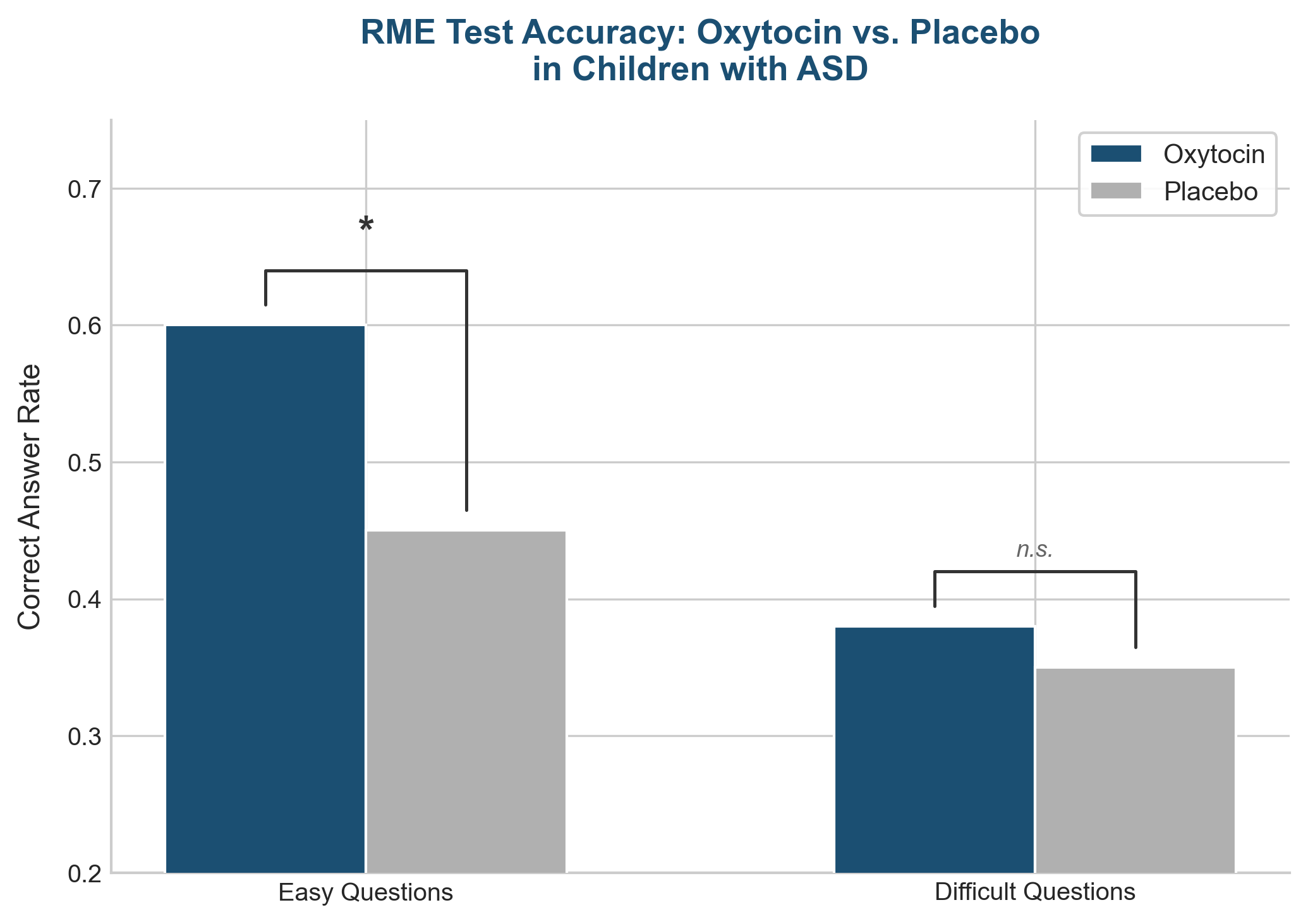
The research was then extended to people on the autism spectrum. In 2013, a team at the University of Sydney recruited sixteen boys with autism spectrum disorder, aged twelve to nineteen, each with a mental age of at least twelve. One group inhaled oxytocin; the other got a placebo. Both then took the RME Test, with questions again divided by difficulty. The oxytocin group scored significantly higher overall, with the biggest gains on the easier items. On the harder items, the gap between groups narrowed. But the takeaway was clear: with oxytocin's help, children with autism had started reading emotions from photographs of eyes.[21-4]
(RME Sample Test — Correct Answer: A: Insisting, B: Tentative, C: Serious, D: Cautious)
Because no definitive treatment for autism spectrum disorder currently exists, these findings generated enormous excitement. Follow-up studies have tested oxytocin across a wider range of autism presentations. Among the most encouraging results: facial recognition difficulties are closely tied to oxytocin signaling, and oxytocin interventions have been shown to improve social relationships in people with high-functioning autism. These are genuinely exciting findings. It should be noted, though, that the field is still young, and some studies have found that inhaled oxytocin does not significantly improve social functioning in all autistic individuals. The relationship between oxytocin and autism is still being debated. But the fact that genetic variants in the oxytocin receptor gene are linked to reduced social ability and higher autism risk makes it hard to dismiss oxytocin's role. As awareness of adult autism grows, combining oxytocin-based approaches with an oxytocin-promoting lifestyle could offer a meaningful path toward improvement.[21-5]