Trust is one of the most important things in human life. A relationship built on solid trust and mutual belief is the foundation of everything — the bedrock we stand on, the stronghold we retreat to. Human civilization itself was built on trust. To live, we have to trust — constantly, unavoidably, in dozens of people we will never truly know. We trust that the bank employee managing our retirement account is not secretly siphoning money. We trust that the surgeon will skillfully remove the tumor from our colon. We trust that the civil servant will not peek at our personal records on a whim. We trust that the subway conductor will get us safely across the bridge over the Han River. Take away any one of these, and we could not focus on our own lives for a single moment.
The Latin word for trust is fides. From it came the English word faith. Both carry the meaning of binding something tightly with a cord. Consider the word fiddle — a medieval nickname for the violin — which also derives from fides. For a stringed instrument to produce its proper sound, each string must be fastened tightly enough to generate the right tension. This is what we call tuning. Even a Stradivarius worth a fortune would be nothing more than an expensive ornament if its strings hung loose.
Oxytocin, the Tuner of Trust
Between people, too, a certain tension in the cord is necessary. This is why we call the bond of faithfulness between spouses fidelity — a word that shares the same ancient root. In Shakespeare's Othello, it was not an enemy's sword but a husband's distrust that destroyed a love that had once burned white-hot. The tragedy began with a single seed of suspicion, planted by the scheming lieutenant Iago. Slowly, Othello began to doubt Desdemona's faithfulness. One by one, the taut strings snapped. Blinded by jealousy, he murdered his wife. Only after she was dead did he learn that she had been faithful all along. He was consumed by remorse — but trust, once shattered, cannot be reassembled, and the dead do not come back. A broken string cannot simply be knotted and reattached to the instrument. It must be replaced entirely. But a string that has merely gone slack? For that, you call a tuner. And that is how the old piano sitting in our living room is reborn as a true instrument through a professional tuner's skilled hands — a careful tightening here, a gentle loosening there.
Have you ever watched how a colleague treats the people around them at work? Imagine a workplace where everyone is relentlessly positive, where people overlook weaknesses and sing each other's praises, where the hardest tasks are tackled voluntarily, where everyone takes care not to inconvenience others, and where every mistake is met with a reassuring "Hey, these things happen" and a comforting pat on the back. That workplace would be nothing short of paradise.
Paul Zak, a professor at Claremont Graduate University and one of the leading researchers on oxytocin and human relationships, calls oxytocin the "Golden Rule hormone." He explains it this way: when someone treats me well, my brain produces oxytocin, and that oxytocin drives me to return the kindness. In my view, this is closer to Rousseau's social contract than to Locke's. Human society runs on mutual trust among its members: *If I help that person, that person will help me. And in practice, returning a favor to someone who helped you when you were down is simply human nature. This is the law oxytocin teaches us.
In 2004, Professor Zak became the first scientist to demonstrate that oxytocin makes people more trusting. He divided participants into two groups — givers and receivers — and handed each giver ten dollars to start a simple trust game. When a giver sent the full ten dollars to a receiver, the receiver's account was automatically credited with triple that amount — thirty dollars. The receiver could then return whatever amount they chose to the original giver. The most mutually satisfying outcome would be for the giver to send all ten, and for the receiver to return fifteen of the thirty, leaving both with fifteen dollars each. The catch was that neither player knew what the other would do. The experiment ran under two conditions. In one, the receiver was told in advance that the giver trusted them and intended to send a generous amount. In the other, nothing was said at all.1
\* The Golden Rule — "Do unto others as you would have them do unto you" — originates in the Bible. It is no exaggeration to say that Western social ethics were built on this single principle.
What happened? Receivers who had been told the giver trusted them showed a fifty percent increase in blood oxytocin compared to the control group, and they returned fifty-three percent of the money they received. Those who were told nothing returned just eighteen percent. The implication is striking: simply knowing that someone trusts us is enough to trigger a surge of oxytocin in the brain. On the flip side, the moment we sense we are being doubted — that stinging feeling Koreans call binjeongsanghada, the sense of wounded pride — we grow defensive and are far more likely to act against the other person's interests.1
This is exactly why a child who has just decided to stop gaming and start studying will suddenly lose all motivation the instant his mother barks, "Go study!" And it is why a pitcher who trusts his fielders to back him up can throw with everything he has on the mound. It does not matter if the batter makes contact — the pitcher believes his teammates will catch whatever comes their way. But a pitcher who suspects his fielders will fumble every ball? His legs will tremble up there, no matter how many zeros are in his contract.
Oxytocin: Growing Trust from Trust
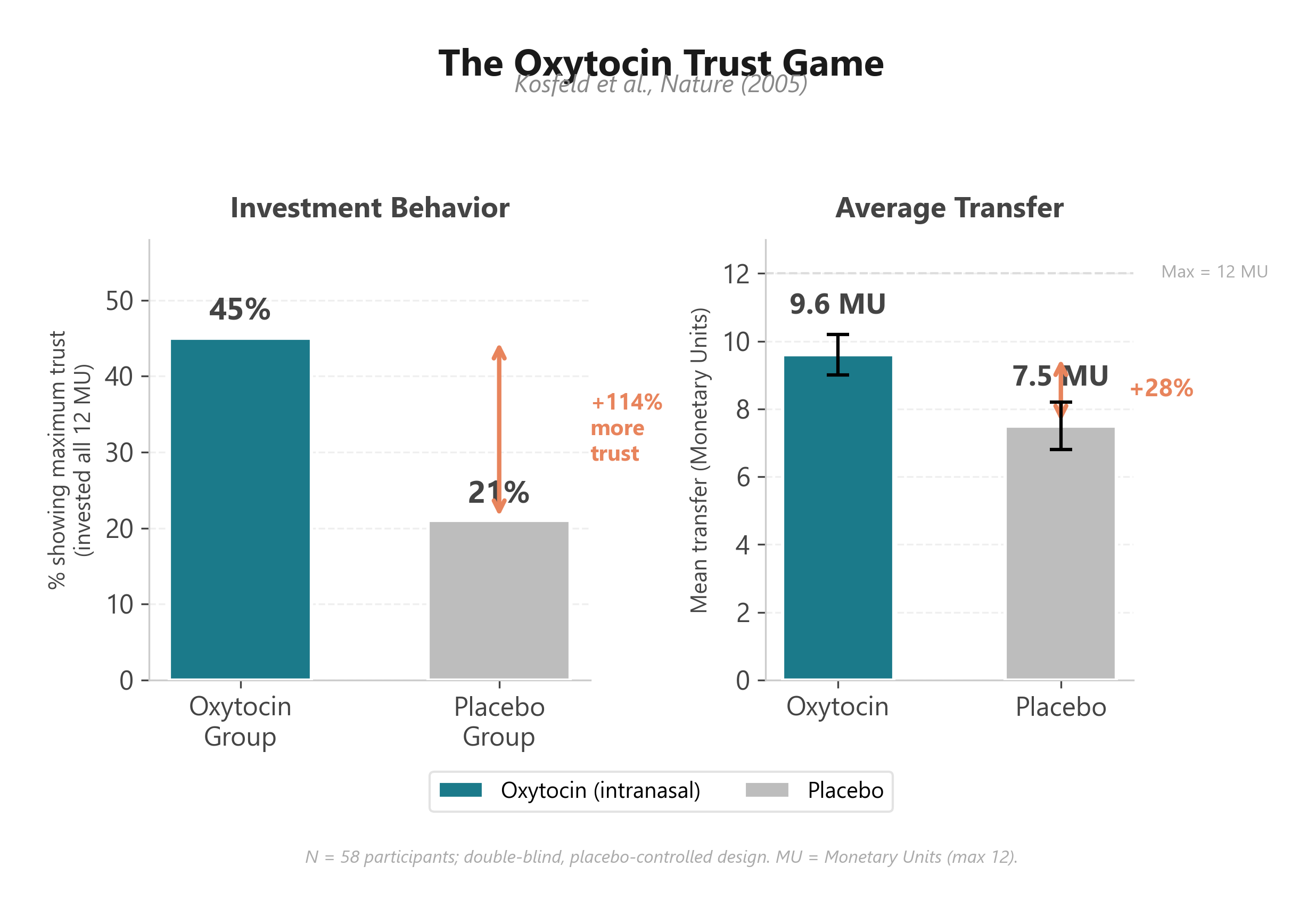
Trust breeds more trust. That is the magic oxytocin works. But does inhaling oxytocin actually make someone more trusting and generous toward others? A landmark experiment at the University of Zurich put the question to the test. Participants inhaled oxytocin and then played an investment game with straightforward rules. Each person in the "investor" role received a sum of money and was encouraged to invest it with four other players. The amount was entirely up to them. If you received 100 euros and invested nothing, the game ended immediately and the 100 euros was yours to keep. But if you invested the full amount in another player, that player's account was credited with three times the sum — 300 euros. The recipient could then return as much or as little as they wished. That meant they could pocket the entire 300 euros, return half — 150 euros — or even give back every cent. So if you were in this game, what would you do? For reference, 100 euros is roughly 143,000 Korean won at current exchange rates.
What did the Zurich team find? Exactly what you might expect. Participants who inhaled oxytocin invested seventeen percent more than the control group, and the proportion who invested the maximum possible amount was twice as high. If I were an entrepreneur, I would want every potential investor's oxytocin levels to be through the roof.
But the initial experiment had a limitation: once the recipient betrayed the investor's trust, there was no recourse and the game simply ended. So the Zurich team ran a follow-up. This time they wanted to know: even after being betrayed — repeatedly — would people who inhaled oxytocin continue to trust and invest? The answer was yes. Even when returns fell short of what they had given, the oxytocin group kept investing. Oxytocin turned out to be a truly remarkable hormone — one that grows trust from trust. And here is what makes it even more interesting: the very act of being kind to someone raises our own oxytocin, and that rising oxytocin makes us kinder still. It is a virtuous cycle of striking elegance.2
These findings carry real weight in economics, and today many marketers are actively applying them. The growing interest in cognitive economics has given rise to an entirely new field called neuromarketing — the science of measuring human physiological and neurological signals to gain insights into customer motivation, preferences, and purchasing decisions. It is now being used in creative advertising, product development, pricing strategy, and more, with brain scans and eye-tracking technology feeding into increasingly sophisticated marketing tools. If you are a business professional heading into a meeting with a major buyer, it may be worth thinking about how to raise that buyer's oxytocin. For practical strategies, see the lifestyle tips for boosting oxytocin in Parts 6 and 7 of this book.3