Years ago, I came across a book called The Origins of Happiness by Professor Eun-Kook Suh of Yonsei University. I read it cover to cover without getting up from my chair. The next morning, still thinking about it, I picked it up and read it again. Then I went through the references.1
The part that stayed with me most was a finding about pain. It turns out that the brain regions that process physical pain and social pain are the same. The suffering of losing a leg in an accident and not knowing how you will make a living is remarkably similar, neurologically speaking, to the suffering of being cut off from your group and having to face life alone. When social pain hits — loneliness, betrayal, the ache of a breakup, the loss of a relationship — the brain generates actual physical pain to prevent us from becoming isolated.
Here is a study that makes the point. Sixty-two college students were divided into two groups. One group received acetaminophen (the active ingredient in Tylenol), and the other got a placebo. The students who took Tylenol reported less distress from social rejection and interpersonal disconnection.2 Think about that: an over-the-counter painkiller reduced the sting of being excluded. As far as the brain is concerned, a broken bone and a broken heart are processed in much the same way.
But the book's most striking conclusion was this: successful people are not the happy ones — happy people are the ones who become successful. Drawing on sociobiological evidence, Professor Suh argues that success does not bring happiness the way we assume it does. We tell ourselves the familiar story: "Sure, I'm struggling now, but just watch — I'll succeed, and then I'll finally be happy." Korean dramas and movies love this narrative, serving up triumphant endings to agonizingly frustrating storylines — what Koreans call a saida (refreshing soda) resolution after a goguma (dry sweet potato) buildup. The problem is that it is not actually true.
Extroverts Are Happier
I recently went back to this book while doing my oxytocin research, and a completely different section jumped out at me. It was the finding that the genes most closely linked to human happiness are those associated with extroversion. Extroverts are significantly happier than introverts — and even introverts report greater happiness when they are with other people than when they are alone. Multiple studies have confirmed this. A joint American-Korean research project found that the happier a person was, the more time they spent with others rather than alone. Unhappy people showed the opposite pattern: they spent far more time by themselves. The takeaway is straightforward — to be happier, spend more time with other people.3
Some readers will push back: "But I'm happier alone!" And that is a fair response — but there is a real difference between choosing to be alone and having no other option. Being alone by choice is one thing. Wanting to see people but being unable to, or avoiding them because of past hurt, insecurity, or depression — that is something else entirely. Just as being unmarried by choice is different from being unable to find a partner, voluntary solitude and involuntary isolation are not the same thing at all.
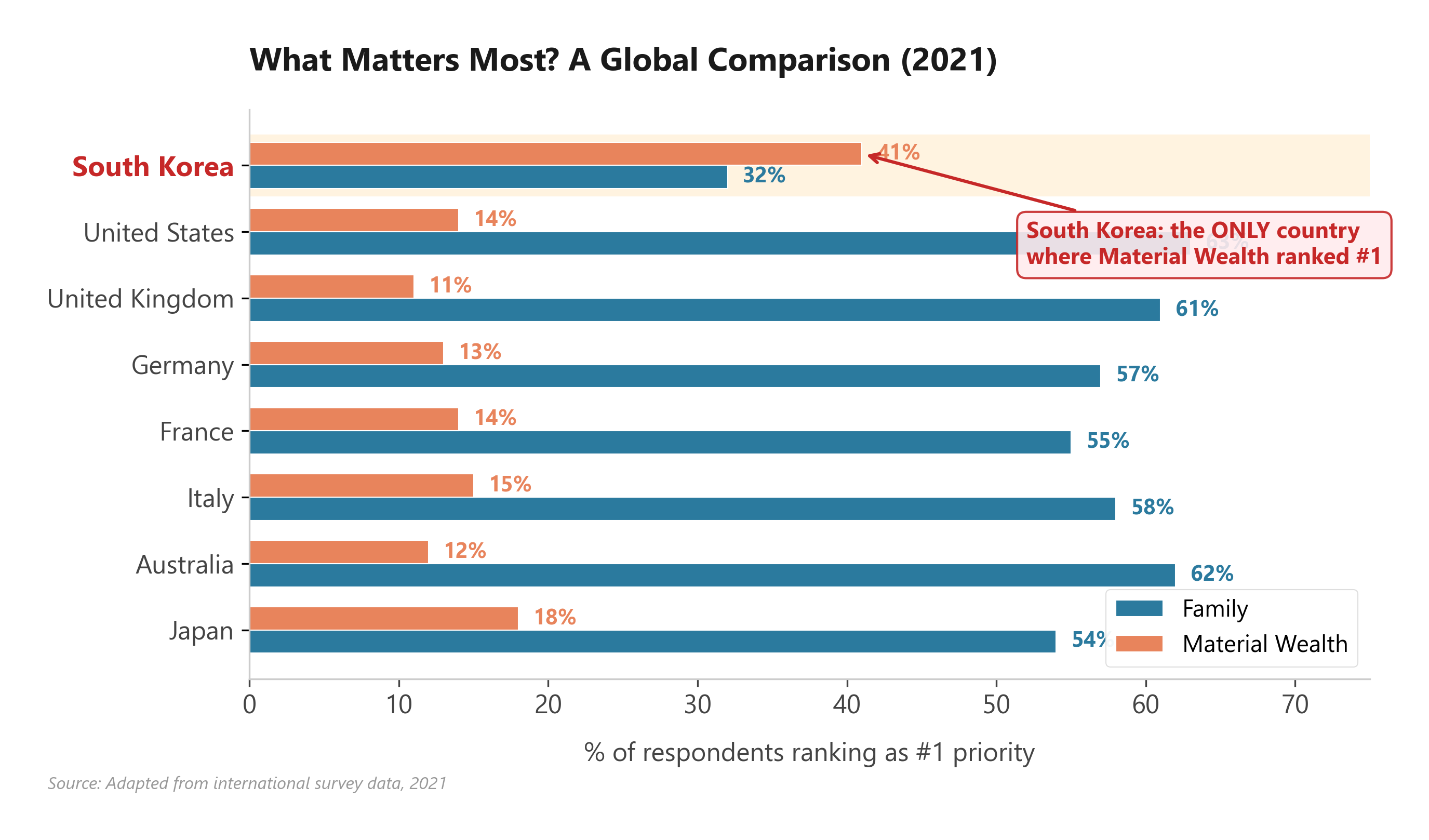
In a 2021 global survey asking what matters most in life, South Korea was the only country to put "material wealth" at the top. In nearly every other developed nation — the United States, the United Kingdom, Germany, France, Italy, Australia, Japan — "family" came first. Korea may be the only country where "Get rich!" serves as a standard greeting and a sincere blessing. This one finding goes a long way toward explaining why Korea's suicide rate is so high and its birth rate so stubbornly low. If a nation's priorities reflect the consciousness and well-being of its people, then Koreans may be looking for happiness in the wrong place.
Oxytocin Is the Glue of Relationships
If extroverts are happier, could it be that people with higher oxytocin are happier too?
The evidence that extroversion is linked to happiness is already well established. The more interesting question is the link between oxytocin and extroversion. Oxytocin is a peptide hormone, which means it needs a receptor to do its work. If a mutation occurs in that receptor, oxytocin's effects are diminished regardless of how much is circulating in the blood. So what about people who carry a mutation in the oxytocin receptor gene known as rs53576 — does their empathy suffer? Does their sociability decline?
Yes. Research has shown that people with oxytocin receptor mutations have lower emotional stability and reduced sociability. Their ability to consider other people's perspectives is also impaired. In other words, if your oxytocin receptors are not working properly, you are likely to have trouble understanding others or picking up on their nonverbal cues. The natural result is a personality that tends toward introversion.
Here is a situation most people can relate to. A girlfriend turns away and says, "Do I really have to spell everything out for you?" while her boyfriend just stands there, completely at a loss. Oxytocin may actually help explain this. Women produce four to five times more oxytocin than men, and with that comes a much finer sensitivity to nonverbal communication. When a woman's unspoken signals go undetected, frustration is almost guaranteed.
Oxytocin in our bodies allows us to empathize with others — to share in their pain and their joy. People with higher oxytocin tend to be more caring, encouraging, trusting, and forgiving. And here is the really interesting part: when we do something kind for someone and see them light up, our own oxytocin goes up even further. Oxytocin operates on a virtuous cycle. People with high oxytocin unconsciously raise the oxytocin levels of everyone around them.
So what should people with lower levels do? Does having less extroversion mean you are destined to be unhappy? Not at all. There are plenty of ways to boost oxytocin.