Turn on the news these days, and the heartbreaking stories come one after another. A young man who failed to find work for years, locked himself in his room, and eventually gave up on life. An elderly mother who waited in a tiny rented room for children who never came — her body found only months later. A child who survived on convenience-store rice balls until malnutrition killed him. A middle-aged man so socially isolated that he died alone and no one noticed. A sick mother who outlived her disabled daughter and wished she hadn't. Stories like these weigh on all of us.
But the world isn't made only of sadness.
There's the daughter who took over her mother's cheonwon-bapjip — a restaurant serving full meals for just one thousand won (less than a dollar) — after her mother ran it for five years feeding people who couldn't afford to eat, until cancer took her life. The daughter now works the restaurant every morning and sells insurance every afternoon. There's the man who drove his own car into floodwaters to save strangers, risking his life in the process. The neighbor who left a basket of snacks by the front door for a taxi driver too busy to stop for a drink of water. The mothers who pray day and night for children who have moved to faraway cities. The sons and daughters caring for parents with dementia, putting their own lives on hold. The couples who will never make the news but who love and cherish each other quietly. The lovers who have nothing but each other and somehow make it enough. The world is full of these warm stories, too.
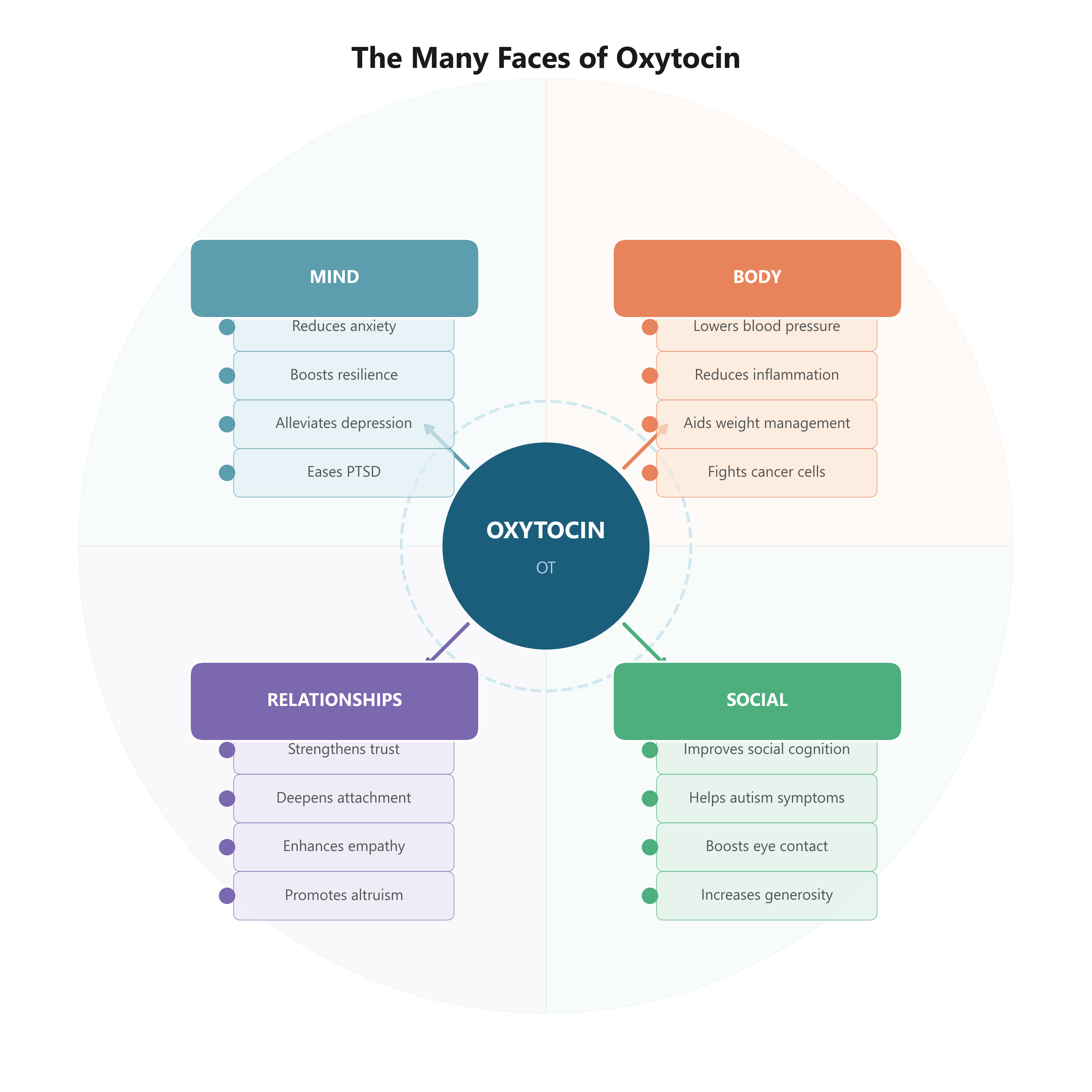
Oxytocin is the hormone that warms the human heart. It's the hormone that helps us trust and love one another more deeply. Now, saying it that way might make oxytocin sound unscientific. But since the first oxytocin-related paper appeared in 1929, a total of 33,423 studies have been published on this molecule through December 2023 alone. So — shall we take a closer look?
## Oxytocin, the Love Hormone
Have you ever heard the word oxytocin? Some readers are nodding; others are drawing a blank. If you've ever had an induced labor, you've almost certainly received an oxytocin injection. Oxytocin causes the uterus to contract, and those contractions signal the pituitary gland to release even more oxytocin. As levels rise, the contractions get stronger. Through this feedback loop, a mother's oxytocin during delivery can reach twenty to thirty times its normal level. That's an extraordinary amount of a single hormone. It triggers an intense maternal bond — the overwhelming urge to hold the baby, to bring the infant to the breast. When a mother's milk lets down and she instinctively guides her newborn to nurse, that's oxytocin doing its job. The hormone literally causes milk to flow from the nipple. It drives the mother to care for her child with deep, instinctive love.
This isn't just intuition — it's been proven in the lab. Researchers found that mother rats deprived of oxytocin completely ignored their pups. And when virgin rats — females who had never given birth — were given oxytocin, they started nurturing the pups in front of them as if they were their own.
Oxytocin is also closely tied to romance. Couples in new relationships have higher blood oxytocin levels than single people. Couples whose oxytocin rose the most in the early days of dating were far more likely to still be together six months later, while those with lower levels were much more likely to have broken up. Early oxytocin levels turn out to be a strong predictor of whether a relationship will last. Given that emotional intimacy and physical touch raise oxytocin, it's not really surprising that couples who start with high levels tend to stay together. Oxytocin is also released during sex, which helps explain the sudden surge of attachment that partners feel after orgasm.
## It Sharpens Social Intelligence
Oxytocin doesn't stop at love. In recent years, researchers have uncovered effects that nobody expected. One of the most striking: oxytocin has a major impact on children's social development. When children on the autism spectrum inhaled an oxytocin nasal spray, something remarkable happened — they began reading emotions from other people's faces. The study that got scientists around the world excited was rigorously double-blind: children with autism spectrum disorder who inhaled real oxytocin detected facial expressions and eye movements far more accurately than those who received a placebo. Follow-up experiments with neurotypical adolescents produced similar results, and the finding is now considered established science. In simple terms, oxytocin has been recognized as more than a love hormone. It's a relationship hormone — a social intelligence hormone.
Are some people naturally low in oxytocin? Yes. Oxytocin is closely linked to a gene called GTF2I, sometimes known as the "sociability gene." People who carry a variation in the oxytocin receptor gene rs53576 tend to show lower empathy. Come to think of it, we all know someone like this. Picture a company dinner in Korea: the junior employees politely say, "Boss, stay a little longer!" — desperately hoping he'll take the hint and leave. Instead, he settles back in with a satisfied grin: "Well, if you insist!" He picks up his glass and launches into "Back in my day..." Completely oblivious. Everyone learns the same truth early in their careers: what employees actually want from the boss at a company dinner isn't his wisdom — it's his corporate card. The right move is to drop the card on the table and make yourself scarce. And as it happens, oxytocin is precisely the hormone that can sharpen someone's social awareness to that level.
Here's an interesting experiment. Researchers had subjects inhale oxytocin and then play an investment game. The oxytocin group trusted their partners more and increased their investments by 27 percent. To rule out a general increase in risk-taking, the team ran additional tests and found no difference at all in risk appetite between the oxytocin and placebo groups. This study was published in Nature in 2005 and has been cited more than five thousand times.
There's another fun one. Researchers recruited 49 couples who had been living together for at least a year, picked the topics most likely to start a fight between them, and then had them argue it out. What a peculiar experiment, right? They videotaped the arguments and analyzed the results. Both men and women who had inhaled oxytocin argued in a much more constructive way — more empathetic, more positive, more inclined toward nonviolent communication. The researchers tried to start a fight, but the oxytocin couples just couldn't manage it.
## Is Oxytocin a Morality Hormone?
There's even research on fidelity. Prairie voles are monogamous — males and females devote themselves to each other. Montane voles, on the other hand, are promiscuous. Not all rodents are the same, it seems. The prairie vole father grooms his pups — licking their fur smooth — and actively helps raise them. The montane vole father doesn't care for his offspring at all. But when researchers modified the montane voles' oxytocin receptors so the hormone could function normally, those formerly indifferent fathers suddenly began caring for their pups. This research is so important that I'll go into much more detail about it later.
Oxytocin's effects have been confirmed in human experiments too. Researchers had married men inhale oxytocin, then sent an attractive young woman to flirt with them. The men were asked how close the woman could get before they felt uncomfortable. The oxytocin group reported discomfort when the woman was about 71 centimeters away. The placebo group didn't feel uneasy until she was just 56 centimeters away — meaning the placebo group let her get significantly closer. Here's the interesting part: this effect only appeared in married men. Single men, whether they'd inhaled oxytocin or a placebo, were perfectly happy to have an attractive woman approach. Exactly as you'd expect.
## The Skin-to-Skin Hormone
And that's not all. Oxytocin also does good things for the body. Recent studies have linked it to cancer, cardiovascular disease, obesity, diabetes, and even aging. Higher oxytocin levels are associated with better odds of preventing cancer, heart disease, obesity, and diabetes. It may also slow aging, speed up nerve cell production, help prevent osteoporosis by supporting bone growth, and accelerate the healing of muscle damage and wounds. There's even research suggesting that raising blood oxytocin levels can improve dementia symptoms. At this point, some of you are probably asking, "Where can I buy the oxytocin spray?"
You don't need to buy anything. There's a way to raise your oxytocin dramatically without spraying anything up your nose. It's touch.
When you were little and your stomach hurt, you ran straight to your mother. She'd rub your belly and say, "Umma son-eun yak-son" — "Mommy's hands are healing hands" — and somehow, the pain would actually go away. That kind of touch triggers the release of oxytocin. When blood oxytocin rises, it raises the body's pain threshold. Our bodies are remarkably selective — they don't send every sensation to the brain. Below a certain level, pain signals are simply filtered out at the peripheral nerves. Studies show that the more skin-to-skin contact parents give a newborn, the higher the baby's oxytocin levels, leading to better emotional health and brain development.
Korean mothers of past generations carried their babies constantly. Even when they went to work, they strapped their infants to their backs in a podaegi, the traditional Korean baby carrier. Western mothers, by contrast, tended to emphasize independence — separate bedrooms, babies sleeping alone from an early age. But recently, this Korean tradition of close physical contact has been getting worldwide attention. The podaegi has gone international. In England, there are shops that rent them out — I looked into it, and a month's rental runs about 16,000 won (roughly ten pounds). You can see the effort Western mothers are making to increase skin-to-skin contact with their babies.
Sharing a meal is another way to raise oxytocin. This was demonstrated in a chimpanzee study. When chimps only groomed each other, their oxytocin didn't rise much. But when they shared food, large amounts of oxytocin showed up in their urine. So if you need to persuade a buyer or build a relationship with a client, maybe skip the long pitch and just share a meal. It might be the most effective way to raise the oxytocin of the person sitting across from you. If that person is your spouse, hold each other close, enjoy some affectionate touch, and share something delicious. If it's a professional relationship, give a warmer handshake than usual, pick a good restaurant, and save the business talk for later. And the next time you tell a friend, "We should get together for a meal sometime," stop just saying it. Make the time. Sit down together, talk and laugh, and actually eat.
## The Gossip Hormone
Here's another way to raise oxytocin: gossip. Does oxytocin spike when you achieve something great in life? Getting into college, landing a job, making money? No. Those moments raise serotonin and dopamine. Oxytocin stays flat. What actually sends oxytocin up is getting together with people and gossiping. When coworkers huddle up to trash-talk the annoying manager, the obnoxious director, or the nightmare client, oxytocin is having a great time.
There's a real study on this. Researchers had one group share emotionally empathetic stories and another group gossip. In the empathy group, cortisol dropped, but oxytocin didn't change. In the gossip group, cortisol dropped and oxytocin went up.
## The Eye-Contact Hormone
One more simple way to raise oxytocin: get a dog. When you pet and hug your dog, oxytocin rises in both of you. Try looking into your dog's eyes while you pet them — eye contact and emotional bonding are a powerful way to boost oxytocin. This isn't just my opinion. It was published in Science in 2015. Researchers have even given oxytocin directly to dogs. Dogs with raised oxytocin levels became more obedient, more social, and made more eye contact with their owners. And here's the fun part: the owners' oxytocin went up too. Isn't that fascinating?
In recent years, as nuclear families, single-person households, and eating alone have become the norm in South Korea, the nation's oxytocin levels have been quietly declining. There's even a new word for it — haek-gaein, "nuclear individual" — describing a level of isolation that goes beyond even the nuclear family. I believe this trend is deeply connected to the rise of school bullying, depression, suicide, mental illness, inflammatory bowel disease, and lifestyle-related diseases. Oxytocin isn't just good for your body. It's a secret weapon for your whole life. What if instead of eating alone, we ate with people we care about? What if we gossiped more, exercised together, played together, visited our parents more often? I want to tell you how oxytocin comforts the heart, how it makes us better people, how it makes us more loving, more responsible. Will you hear me out? Discovering oxytocin resolved many problems in my own life and made it much richer. I hope that through this book, your life becomes happier, fuller, and more beautiful.
From my laboratory in Sinchon, The Author
Imagine there were a wonder drug. Take it, and you suddenly become kinder. You notice the good in people instead of the bad. When someone makes a mistake, you understand their perspective, forgive them, and respond with generosity. On top of that, this drug prevents obesity, diabetes, cardiovascular disease, and cancer. It treats chronic pain, insomnia, anxiety, depression, and inflammatory bowel disease. And if a teenager with autism spectrum disorder takes it, they start reading emotions on other people's faces for the first time. If such a drug existed, would you want to know about it? It. Does. Exist. It is oxytocin — produced in the posterior pituitary of the hypothalamus. In Part 1, I'll tell you all about this remarkable substance.